Six AI agents.
One travel platform.

Most "AI travel" is a chatbot bolted onto one booking engine. Ours is six agents on one platform — booking, hotel savings, airline credits, receipts, policy and traveler safety — sharing the same orders, rules and audit trail. Robert is the one your team will know by name.

Web · Slack · Teams · Telegram · MCP 30+ suppliers in one agent Every action confirmed and logged
6 AGENTS · LIVE
MCP
CORE · MCP Travel Code
Platform
robert
rateguard
credit-recovery
ocr-reader
duty-of-care
policy-builder

A chatbot answers questions. An agent does the work.

Most corporate travel platforms launched "AI assistants" in the last 18 months. They look like chat windows — type a question, get an answer. The pattern is the same: a conversational layer sitting on top of legacy infrastructure that hasn't changed.

An agent is different. An agent has tools. It can search live content, book a hotel, cancel it, file the expense and message the traveler — after a clear yes, with an audit trail. It runs on a schedule, watches for events, hands off to a human when unsure.

Travel Code agents share one platform: RateGuard rebooks a cheaper hotel and the order shows it, Credit Recovery puts an unused airline credit in front of the traveler at search, Robert watches the flight and messages the traveler. One set of orders, one policy, one audit trail.

Chatbot
Agent
What it does
Answers questions
Takes actions
When it runs
When you ask
Continuously, on triggers
State
Stateless or session-based
Persistent memory + audit trail
Talks to others
No
Yes — MCP for ChatGPT, Claude and your agents
Failure mode
Wrong answer
Escalates to human, logs the why

Robert. Your travel and finance ops, on call.

Robert is the agent your travelers actually talk to. He searches live content, books after a clear yes, answers policy and visa questions, watches flights, and respects every user's role and access level. He lives on every page of the platform and in your messengers.

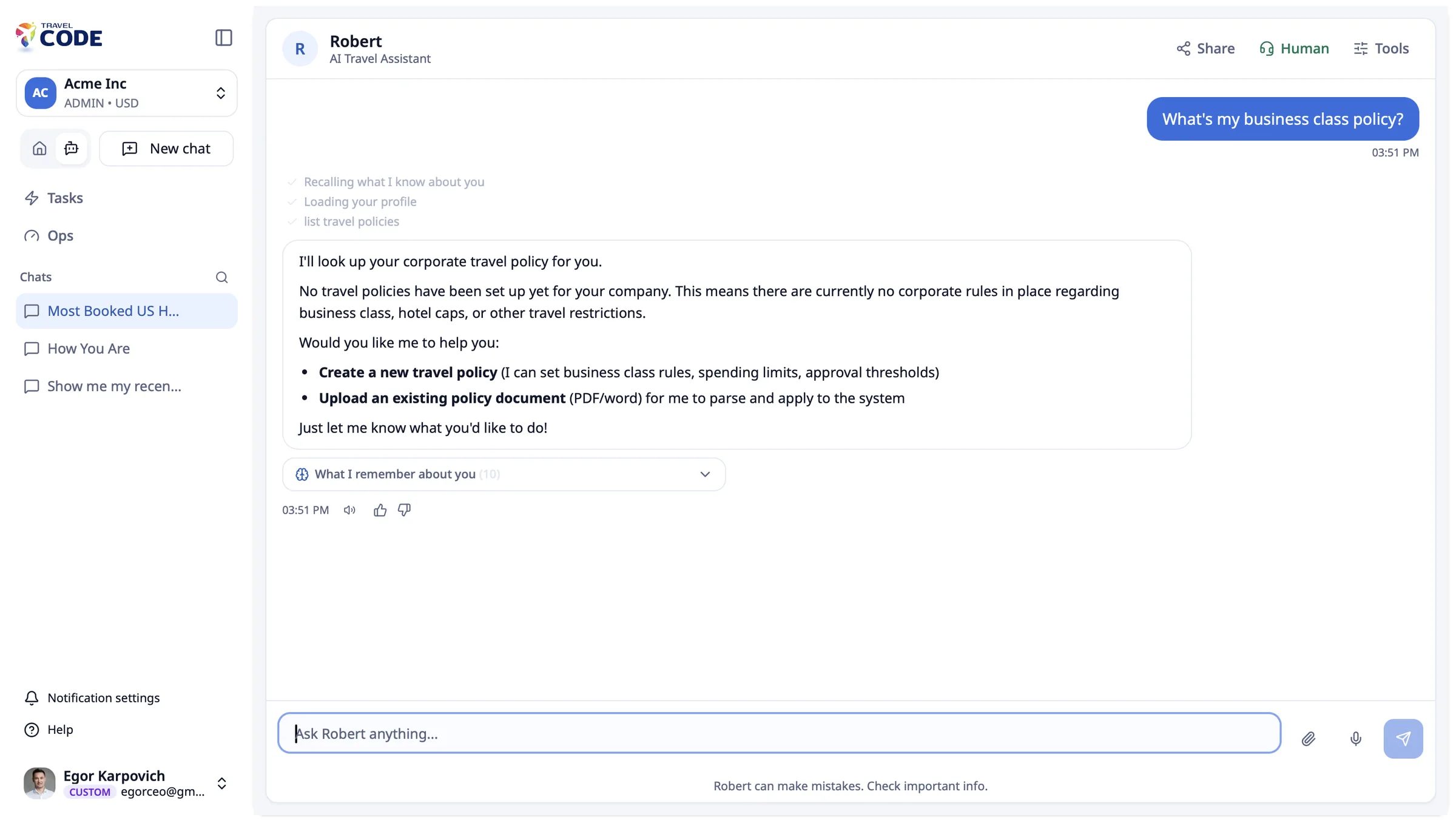
Robert, the AI travel assistant, answering a question about the company business-class policy

What Robert can do

  • Search and book flights, hotels, rail, car rental and transfers worldwide, within your travel policy
  • Watch your flights and, on a delay or cancellation, message the traveler with alternatives ready to rebook
  • Check visa rules and file eVisas, find airport lounges, answer policy and how-to questions
  • Change or cancel bookings — with change and cancellation terms checked first
  • Build reports and analytics in chat: spend, suppliers, CO2, expenses
  • Duty of care: show where travelers are, flag risk alerts by country, message the people affected
  • Read your travel policy, flag out-of-policy options, and build a policy from your PDF
  • For TMC and travel desk staff: order analytics, what needs attention, merge, rename and edit orders across clients
  • Hand off to a human travel agent with full context, any time
  • Respect roles: a traveler sees their own trips, a director sees their company — the same access as on the site

What Robert won't do

  • Make bookings outside policy without escalation
  • Disclose other travelers' data to non-authorized users
  • Book, cancel or spend without your explicit yes in a separate message
  • Pretend to know answers it can't verify (it links to the source)

Robert lives on every page of the platform, in Slack, Microsoft Teams and Telegram, and inside ChatGPT, Claude and other AI assistants through our MCP server.

The first AI agent that runs a TMC.

Travel desk and TMC staff get the same Robert with super-powers: questions about every client and every order are answered in chat, and routine order work is done in a sentence — with the same permissions as on the site.

Analytics in chat

“How many orders did this client have in October?” — totals and statuses for one company or all of them.

What needs attention

Orders waiting for confirmation, cancellations in progress, overdue payments — one question, one list.

Order work in a sentence

Merge duplicate orders, rename them, update supplier costs and booking references — each change confirmed and logged.

All the content. One agent.

Most AI travel assistants sit on a single GDS or a handful of chains. Robert searches the full Travel Code supply worldwide — GDS, NDC, low-cost carriers, bedbanks, rail, car rental, transfers, visas and lounges — and books from the same results your travelers see on the site.

Flights

Amadeus including NDC, plus direct and low-cost carriers worldwide.

Hotels

Expedia and dozens of bedbanks and wholesalers worldwide, compared room by room.

Rail

Rail worldwide, high-speed lines included, with seats and fares in one search.

Transfers

Airport and city transfers worldwide from several providers, priced up front.

Car rental

Major rental brands at airports and in cities, with your corporate discount codes.

Visas and lounges

Entry rules and eVisa filing for the traveler's passport; lounge passes at airports worldwide.

Your rates come along

Your corporate codes for airlines and car rental are applied automatically for your company. Your own GDS office or hotel contracts are connected as a project with our team.
How Robert compares.

The other AI travel agents for business, side by side.

Robert · Travel CodeBizTrip AISerko.aiSkyLink · Amadeus
Where it worksWeb, Slack, Teams, Telegram, ChatGPT and Claude (MCP)Web, iOS, ChatGPT and ClaudeWebSlack, Teams
FlightsAmadeus incl. NDC + direct and low-cost carriers worldwideSabreYesGDS through your TMC
HotelsExpedia + dozens of bedbanks worldwideSabreYesGDS
RailWorldwide—PlannedEurostar (UK)
Car rentalSearch in chat, corporate codes appliedSabrePlannedYes
Transfers, visas, loungesAll three, bookable in chat——Visa questions
Changes and extrasChange, cancel with terms checked first; add lounges, transfers, visasChanges in chatChanges in chat, refunds via HopperCancel or change
Travel policyApplied in search; built from your PDF; approvalsApplied before booking; approvalsFrom PDF or chat; out-of-policy ranked lowerMatched automatically
Reports and analyticsSpend, suppliers, CO2 — in chat and on the platformSavings dashboardSpend report for managersThrough your TMC
TMC operationsAnalytics, ops queue, merge and edit orders in chat——Serviced by your TMC
Duty of careTraveler map, risk alerts, message the affected——Through your TMC
ExpensesReceipts, expense reports, policy flagsTrip cost captured at bookingItemized receiptsProject codes
Flight disruptionsAlert with alternatives, rebook after a yesAlternatives offeredAlternatives offeredNot stated
Before any bookingExplicit yes in a separate message, loggedConfirm before purchaseYou confirm every tripNot stated
Hotel price dropsRateGuard rebooks and logs savingsRebooks automatically——
Airline creditsTracked and offered first at search———

Other products: from their public websites and press, October 2026. "—" means we found no mention. Spotted something out of date? Tell us and we will fix it.

RateGuard. Watching every hotel booking. Forever.

You book at the best rate you can find. Then prices drop. RateGuard watches every hotel reservation after issuance. When the rate goes down, we void and rebook within the property's rules. You keep 20% (Premium) or 50% (Pro) of the savings.

Flights coming soon

Example of a RateGuard log

Property · Stay
Original
Rebooked
Saved
Your share
Marriott Marquis · NYC · 3 nt
$1,284
$1,140
−$144
Park Hyatt · Tokyo · 2 nt
$940
$812
−$128
Four Seasons · Riyadh · 4 nt
$2,180
$1,980
−$200
Soho House · Berlin · 2 nt
$760
$688
−$72
Mandarin Oriental · London · 3 nt
$1,540
$1,388
−$152
Hyatt Regency · Chicago · 2 nt
$890
$806
−$84

Most travel platforms claim "best rate guaranteed" — and most don't follow through. RateGuard makes the claim auditable. Every hotel reservation has an entry. Every refund has a timestamp, an amount, and a destination. Your finance team can export the full log to CSV.

In practice, RateGuard captures meaningful savings on a sizable share of monitored hotel reservations — every rebook is logged with the original rate, the new rate, and the audit trail attached to the booking record.

Credit Recovery.
Never lose another airline credit.

Industry data: companies your size leak $80K–$200K per year on expired airline credits. They sit in airline portals, attached to former employees, and quietly disappear at the 12-month mark. Credit Recovery hunts them down, applies them, and reassigns them when employees leave.

01

Auto-track

Every credit from every airline in every traveler's account, in one dashboard. Live balances, expiration countdowns, transferability flags.

02

Auto-apply

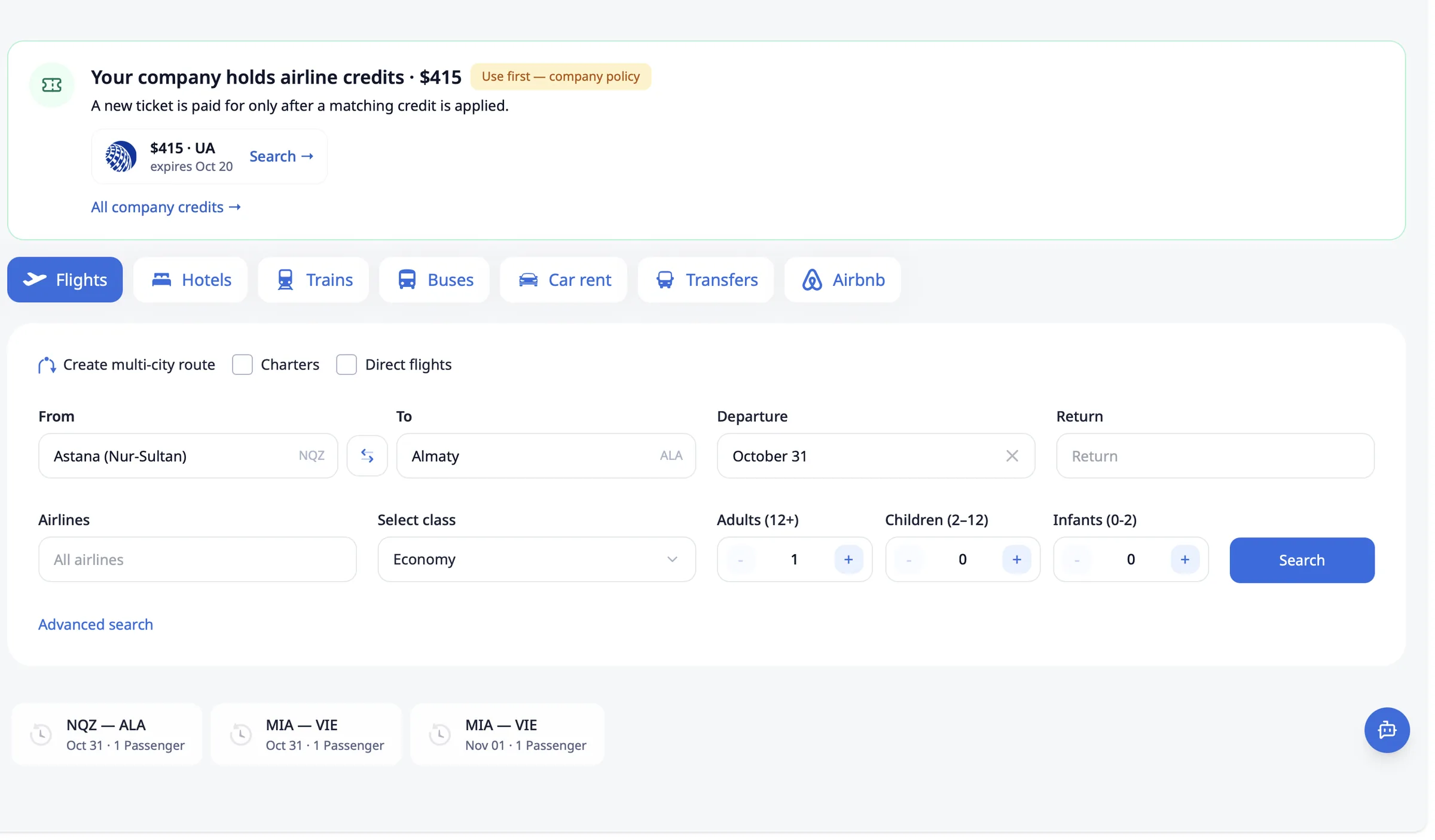
At search time on the same airline, the credit is shown first, per company policy — so it gets used before it expires.

03

Auto-reassign

When an employee leaves, transferable credits move to the company pool — eligible for any other traveler within the airline's rules.

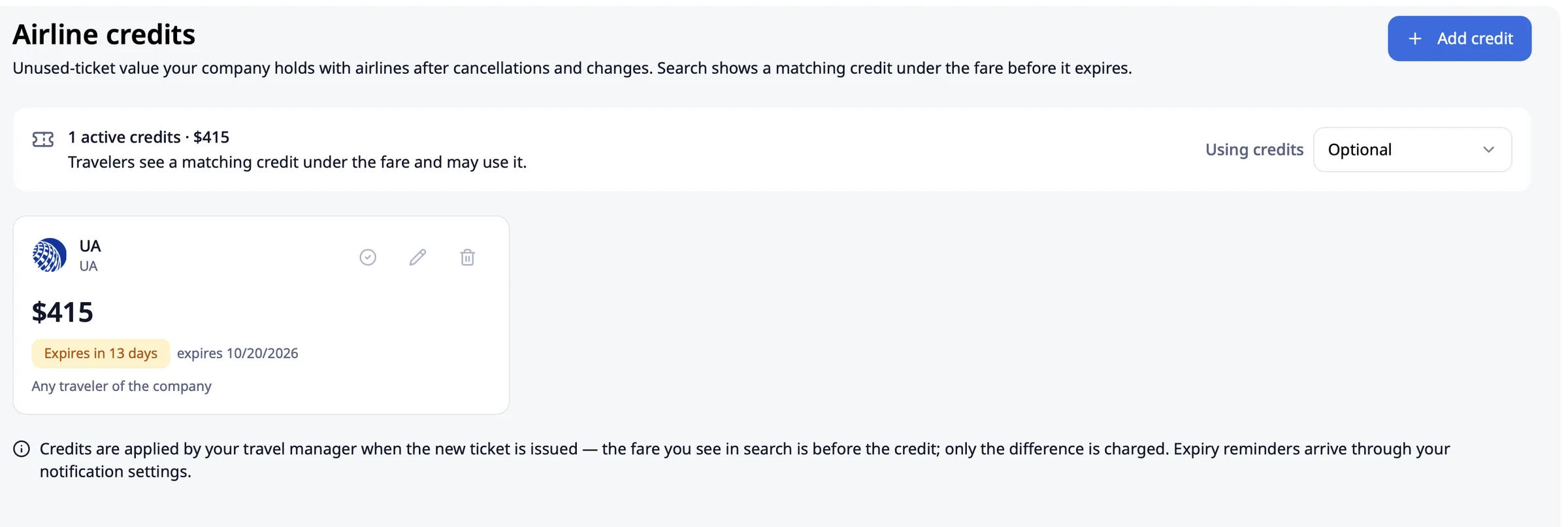
Airline credits: unused-ticket value the company holds with airlines, with expiry countdown and who may use it
Search page reminding the traveler that the company holds an airline credit to use first, per company policy

Three more on the team.

Policy Builder · Beta

Policy as configuration, not code

Upload your existing 30-page travel policy as a PDF. Our agent reads it, flags ambiguous rules, and turns it into platform rules — cabin restrictions, hotel caps, approval workflows, group-based rules. You review every rule before it goes live.

Setup walkthrough →
OCR-Reader · Live

Receipts, line by line

Most expense platforms read receipt totals. We read every line. Coffee, room service, parking, tip — each item categorized, each VAT split, each policy violation flagged.

See itemized OCR →
Duty-of-Care · Live

Where every traveler is, in real time

Where every traveler is, from bookings and forwarded itineraries. Country risk and weather alerts. Company protocols that message affected travelers and their managers the moment something happens.

Visit duty of care →

One platform,
one audit trail.

Agents propose and prepare. People decide. Every booking, change or cancellation runs only after a clear yes, and the order history records who asked for it.

A flight is delayed. Robert sees it on the trip he watches, messages the traveler in Slack, Teams or Telegram with alternatives inside the policy, and opens the chat with the options ready. The traveler picks one and confirms. The order history reads "Robert (AI assistant) on behalf of the traveler".

This is what "AI" should mean. Not a chat box that knows your policy — specialists that own their part of the workflow, inside the rules you set.

Flight watchDetects a delay or cancellation on a booked flight
RobertFinds alternatives within the policy → messages the traveler with a link to them
TravelerPicks an option and confirms in a separate message
RobertBooks it or hands it to the travel desk with full context → logged in the order history
MCP
Open to ChatGPT, Claude and your own agents
Yes
Every write needs a clear yes in a separate message
Log
Every action recorded in the order history
Roles
Same access as the user has on the site

What we don't pretend.

Marketing AI is easy. Shipping it responsibly is harder. Here's what we explicitly don't do — and why.

No agent books, cancels or spends on its own.

Every booking, change and cancellation is shown as a card and runs only after the user confirms in a separate message. The agent cannot confirm for them. The AI proposes, the human approves.

No agent shares data outside its permission scope.

A traveler can't query other travelers. A director sees their own company. The agent acts with the user's own login, so it can never see more than the user sees on the site.

No agent fakes confidence.

If Robert can't check something, he says so and links to the source. Prices and availability always come from a live search, never from memory.

No agent replaces your finance team.

Agents handle the volume. Humans handle the judgment. We've seen vendors pitch "AI replaces your accountant" — that's not us. Your CFO still owns the close.

Questions, answered.

Architecture, safety, content, privacy — the ones we hear most. Talk to a product specialist if yours isn't here.

Is this all just GPT or Claude wrapped in a UI? +
No. Robert runs on leading language models and switches to another one automatically if a model is unavailable. The model is the brain; we built everything around it — live content from 30+ suppliers, your policy, your orders, roles, memory, confirmations and the audit trail.
Can we bring our own content and negotiated rates? +
Yes. Your corporate codes for airlines and car rental are applied automatically for your company. Connecting your own GDS office or hotel contracts is a project with our team — tell us what you have and we will scope it.
What happens if an AI agent makes a mistake? +
Three layers of protection: (1) nothing is booked, changed or cancelled without the user's explicit yes; (2) the agent sees only what the user can see on the site; (3) every action is logged in the order history with who asked for it — review and reverse after the fact.
Can I see Robert before signing up? +
Yes. Book a demo and we'll give you a sandbox with your travel policy loaded. You talk to Robert, ask anything, see the responses, see the audit logs. No commitment. Most prospects spend 30–60 minutes in the sandbox before deciding.
What does RateGuard actually do? +
RateGuard watches every hotel reservation after issuance. When the price drops, we void and rebook within the property's rules. On Premium plan we return 20% of the savings; on Pro plan we return 50%. Flights are coming soon.
Are agents available in Slack and Telegram? +
Yes. Robert works in Slack, Microsoft Teams and Telegram and sends flight alerts there. He is also available inside ChatGPT, Claude and other AI assistants through our MCP server. Other agents report through the platform.
What's the privacy model — does the AI train on my data? +
No. We do not train models on your data. Customer data is isolated per company, and agent memory is kept per user.

See Robert and friends in your travel program.

30-min demo. We'll load your policy, run your real routes through Robert, and send you a sandbox. No pitch.